
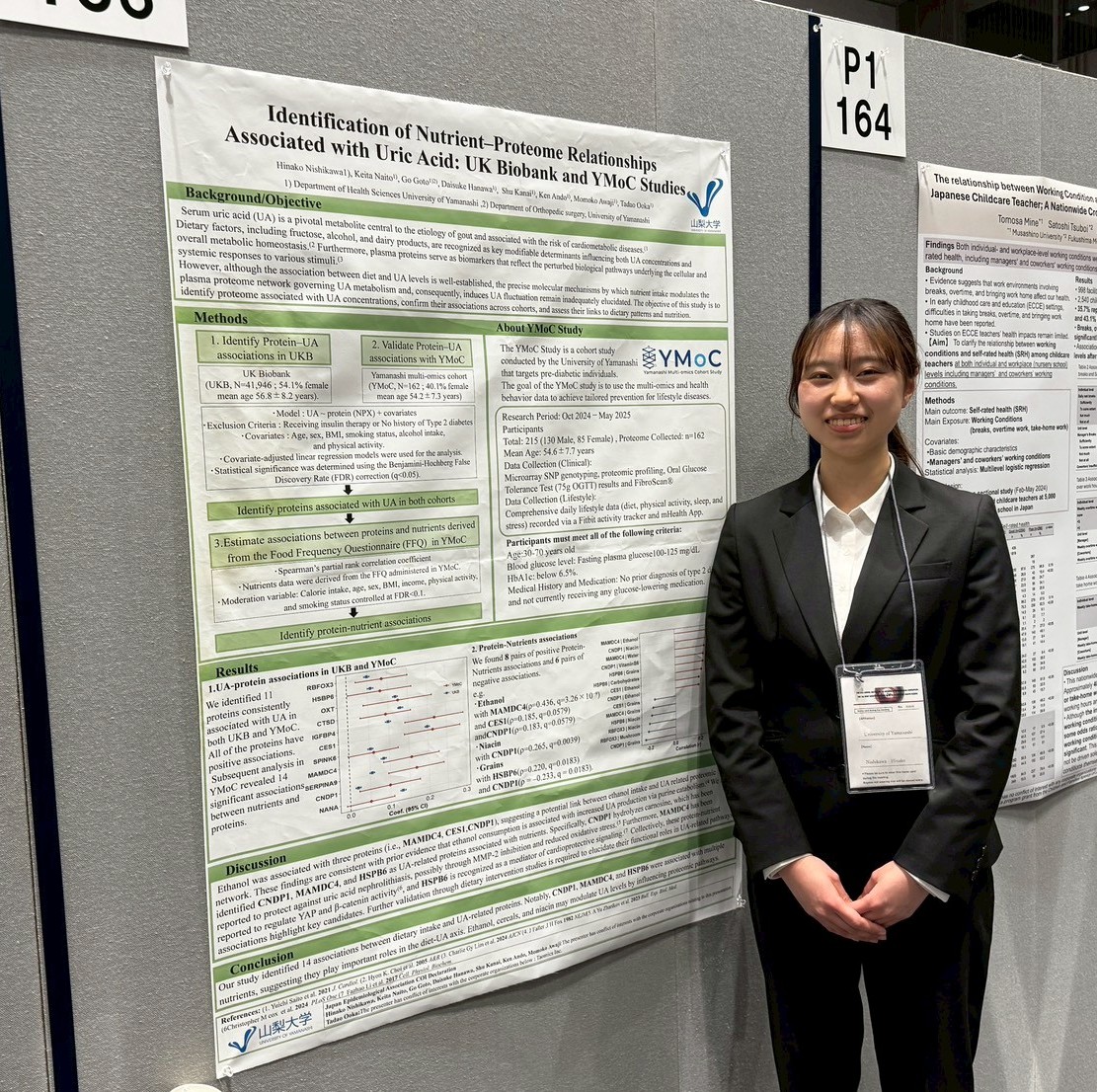
この度、1月28日から30日に行われました第36回日本疫学会学術総会に参加させていただき、「Identification of nutrient–proteome relationships associated with Uric Acid: UKB and YMoC study(尿酸に関連する血漿タンパク質と食事要因との関連:UKB&YMoC研究)」というタイトルでポスター発表を行いました。
初めて国際学会に参加し、国内外の研究者の方々の発表を聞いたり、英語で質問をしたりすることができ、非常に貴重な経験となりました。自分のポスターの内容について複数の質問をいただき、社会医学講座で行っているYamanashi Multi-omics Cohortに関する研究への注目度の高さを肌で感じることができました。
また、自分と同じようにポスター発表や口頭発表を行っている学部生の方々の発表を聞き、交流できたことは今後の研究への刺激になりました。
最後になりますが、貴重な経験の機会をくださいました、日頃よりご指導くださっている社会医学講座の大岡准教授をはじめとする先生方、そしてご支援をいただきましたライフサイエンスコース事務局の皆様に厚く御礼申し上げます。今後も精進してまいりたいと思います。
以下発表の抄録となります。
Background: Serum uric acid (UA) is linked to gout and cardiometabolic diseases. Plasma proteins can reveal biological pathways, and diet is a major modifiable factor influencing UA levels.
Objective: To identify proteomic biomarkers for UA, validate them across cohorts, and assess their links to dietary patterns.
Methods: In a two-stage design, protein data underwent quality control, log2 transformation, and z-standardization. Protein–UA associations were identified in the UK Biobank (UKB; N=41,946; 54.1% female; mean age 56.8±8.2 years) using covariate-adjusted linear regression with Benjamini–Hochberg FDR (q<0.05). Findings were validated in the Yamanashi multi-omics cohort (YMoC; n=162; 40.1% female; mean age 54.2±7.3 years), requiring concordant direction and significance (FDR<0.05). Significant proteins were then used for dietary analysis. Spearman’s partial rank correlations between the identified proteins and energy-adjusted dietary intake from the Food Frequency Questionnaire (FFQ) were estimated, adjusting for age, sex, BMI, smoking, physical activity, and income. Multiple testing for nutrient–protein pairs was controlled using FDR<0.1.
Results: Eleven proteins showed replicated associations with UA across UKB and YMoC (e.g., apical endosomal glycoprotein [MAMDC4], beta-Ala-His dipeptidase [CNDP1], heat shock protein beta-6 [HSPB6]; q<0.05, respectively). In YMoC, 14 significant nutrient–protein associations were identified. Ethanol was positively associated with MAMDC4 (r = 0.436, q<0.001), and niacin with CNDP1 (r = 0.265, q = 0.0039). Cereal intake was positively associated with HSPB6 (r = 0.220, q = 0.0183) and inversely associated with CNDP1 (r = –0.233, q = 0.0183).
Conclusion: We identified links between dietary intake and UA-associated proteins. Alcohol, cereals, and niacin may influence UA via proteomic pathways. Further research is needed to confirm causality through dietary intervention studies.

