
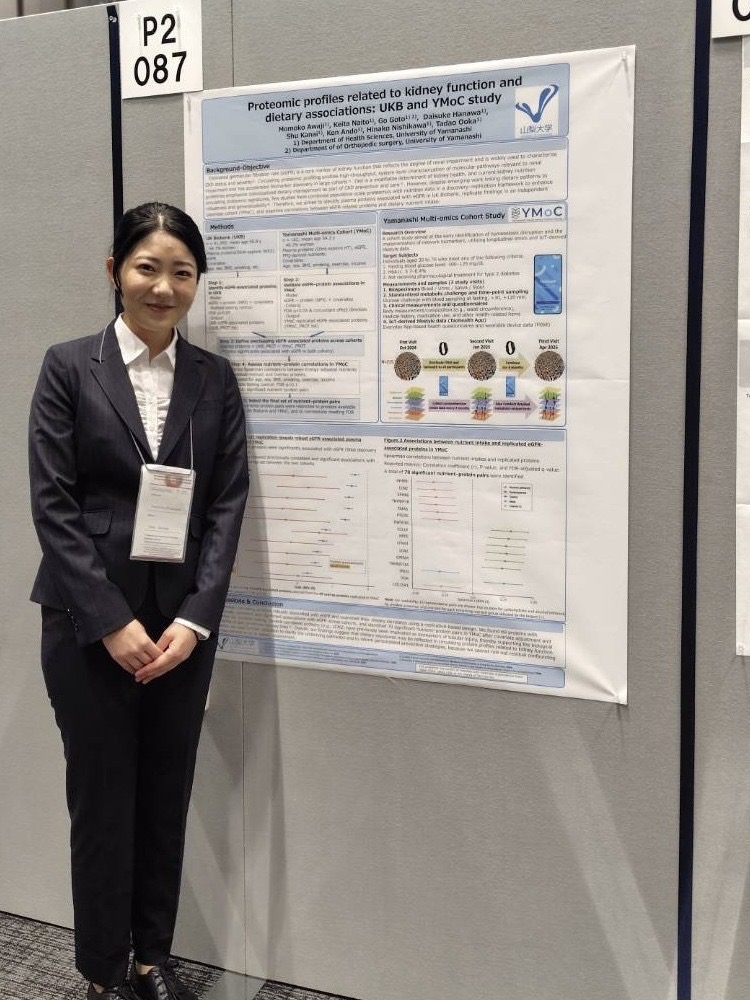
2026年1月28日〜30日に長崎県・出島メッセ長崎にて開催された、第36回日本疫学会学術総会(JEA)・第3回国際疫学会西太平洋地域合同学術集会(JEAWPR)において、ポスター発表を行いました。
これまでにも学会発表の機会はありましたが、国際学会での発表は今回が初めてでした。英語での発表資料作成には不慣れな点も多く、準備の過程で戸惑うこともありましたが、学術な英語表現を学ぶ良い機会となりました。今回得た知見は、今後の論文作成や文献抄読にも活かしていきたいと考えています。
当日は多くの研究者の方々に発表内容へ関心を寄せていただき、貴重なご意見・ご助言を多数頂戴しました。海外からの参加者も多く、活発な質疑や交流を通じて大きな刺激を受けました。
本発表では、山梨大学社会医学講座で実施しているYMoC study(Yamanashi multi-omics cohort study)で収集されたデータを用いて解析を行いました。データ収集から解析、発表に至る一連のプロセスとその難しさを実感し、研究活動の実際を学ぶことができた点は大変貴重な経験でした。加えて、分子疫学という私にとって初めての領域での発表であり、基礎的事項の理解にも苦労しましたが、解析の奥深さを実感しながら楽しく学ぶことができました。
今回の発表が、学生として最後の学会発表となります。これまでライフサイエンスコースで得た経験と学びを大切にし、今後も研究活動に励んでいきたいです。
最後に、本発表にあたりご多忙にも関わらず熱心にご指導いただきました大岡准教授をはじめ社会医学講座の先生方、ならびにライフサイエンスコースの先生方・事務局中村様に、心より御礼申し上げます。
以下は抄録です。
Title: Proteomic profiles related to kidney function and dietary associations: UKB and YMoC study
Background:
Estimated glomerular filtration rate (eGFR) is a key marker of kidney function. Circulating proteomic profiles capture molecular pathways of renal impairment, and diet is a modifiable determinant of kidney health. However, few large-scale discovery–replication studies have integrated proteomics with nutrition data.
Objective:
To identify plasma proteins associated with eGFR, replicate findings across cohorts, and examine correlations with dietary nutrient intake.
Methods: We applied a two-stage discovery (UK Biobank, UKB) and replication (Yamanashi multi-omics cohort, YMoC) design. In UKB (n=41,992; mean age 56.8y; 54.1% women), associations between eGFR and plasma proteins were evaluated using covariate-adjusted linear regression models, controlling the false discovery rate (FDR) at q<0.05. Replication in YMoC required concordant effect direction and q<0.05. In YMoC (n=162; mean age 54.2y; 40.1% women), we analyzed correlations with energy-adjusted nutrient intakes from a food frequency questionnaire (FFQ). Partial Spearman correlations between residualized nutrients and proteins were calculated, adjusting for age, sex, BMI, smoking, exercise, and income, with FDR controlled at q<0.1.
Results:
We identified an overlap set of 69 proteins significantly associated with eGFR in both cohorts. Among the 69 replicated proteins, 140 nutrient–protein pairs were significant (q<0.1). Ethanol intake showed a moderate negative correlation with beta-2-microglobulin (B2M), a marker of renal dysfunction (r=-0.333, q=0.0027). Carbohydrate intake was positively associated with insulin-like growth factor binding protein 2 (IGFBP2), involved in metabolic and renal pathways (r=0.322, q=0.0074).
Conclusion:
Using a replication-based design, we identified eGFR-related proteins and their dietary correlates. The observed significant correlations suggest diet–proteome–kidney links. Further validation is needed to clarify pathways and contribute to personal prevention.

