
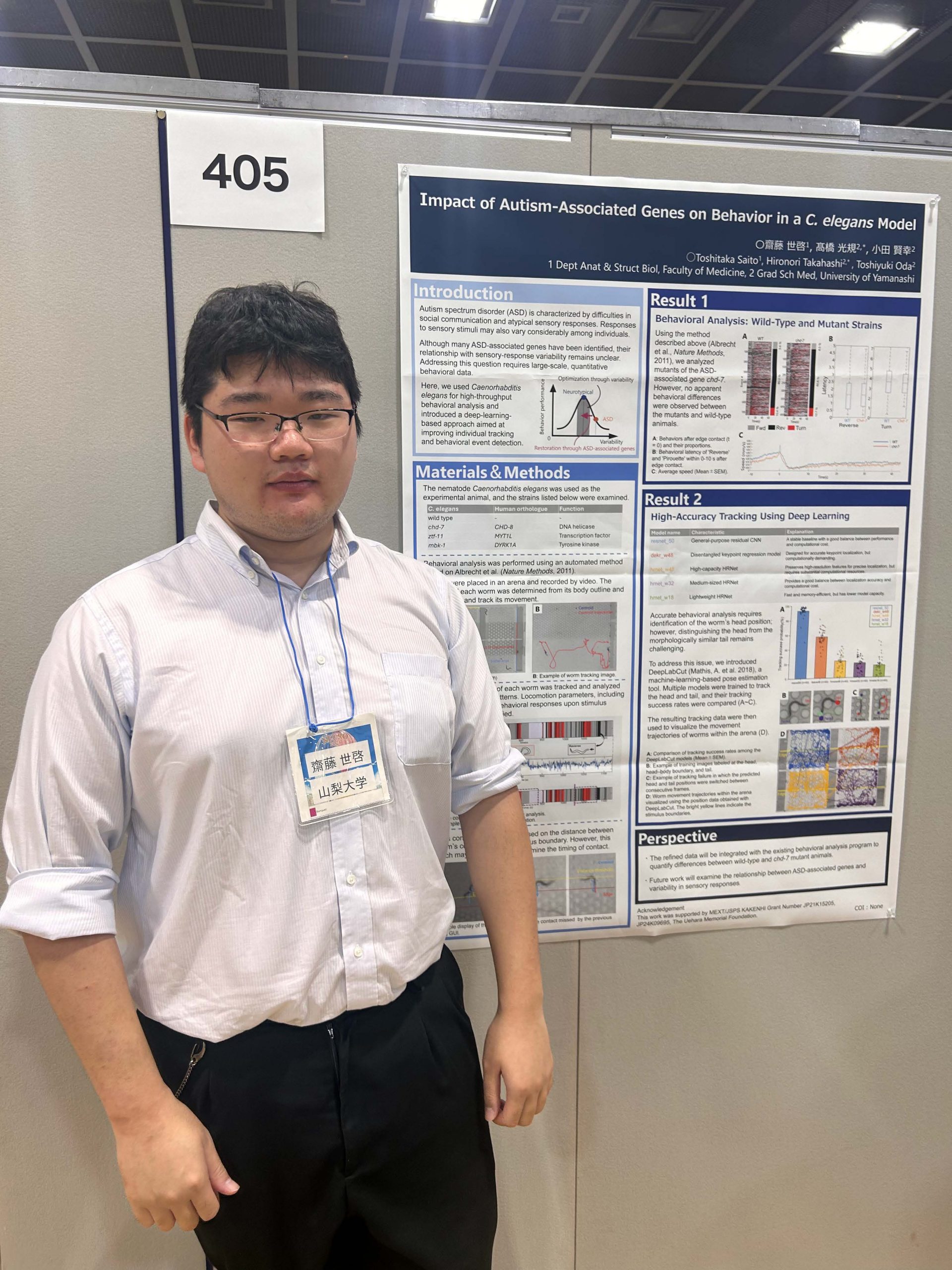
この度、神戸国際会議場・神戸国際展示場で開催された NEURO2026 にて、「線虫モデルにおける自閉症関連遺伝子が行動に与える影響の解析」というテーマでポスター発表を行いました。
一昨年より学会発表の機会を重ね、少しずつ規模の大きな学会に参加してきましたが、今回は国際学会というこれまで以上に大きな場での発表となりました。これまで参加してきた学会とは異なり、幅広い研究分野の方々と交流しさまざまな視点から意見や助言をいただくことができ大変貴重な経験となりました。今回得られた知見や気づきを、今後の研究活動に活かしていきたいと思います。
末筆ながら、本発表に際しご指導・ご支援を賜りました小田教授、高橋先生をはじめ、構造生物学講座の皆様、ならびにライフサイエンスコース事務局の皆様に、心より御礼申し上げます。
以下、発表テーマの抄録となります。
Behavioral analysis is an essential methodology for elucidating how neural circuits and genes regulate animal behavior. The nematode Caenorhabditis elegans (C. elegans) is small and transparent, which facilitates imaging, and approximately 40% of its genes are homologous to human genes, making it a well-established model for studying disease-associated genes. In particular, the use of microfluidic devices enables precise control of sensory stimuli and quantitative evaluation of individual behavioral responses, providing a powerful platform for investigating genetic mechanisms of neural function using behavior as a readout.
We quantified behavioral responses to osmotic stimuli in wild-type animals and chd-7 mutants, an autism spectrum disorder (ASD)-associated gene. Quantitative analysis of behavioral responses triggered by contact with stimulus boundaries revealed no prominent differences between wild-type and mutant animals; however, certain parameters, such as response latency, exhibited inter-individual variability. These results suggest that detailed quantitative behavioral analysis can uncover subtle behavioral phenotypes that may not be detected using conventional approaches. However, the previous analysis was limited by the inability to discriminate between the head and tail of the animals, reducing the reliability of behavioral measurements.
In this study, we improved an existing automated behavioral analysis method by incorporating deep learning-based head and tail discrimination using DeepLabCut. This improvement enabled accurate identification of head and tail positions, allowing precise analysis of the timing at which animals encountered sensory stimuli. Using this refined method, we compared the behavioral responses of wild-type and ASD-mutant animals.
This approach provides a foundation for precisely capturing behavioral variability arising from genetic background and is expected to facilitate future detailed behavioral analyses and improve our understanding of the functions of ASD-associated genes.

